
AES-128/256 Encryption
Combined encrypt/decrypt engine with DMA streaming
Security IP
Overview
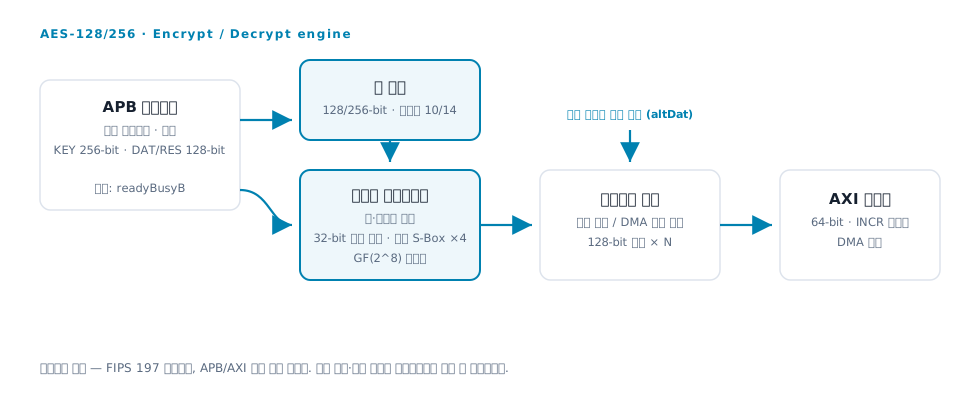
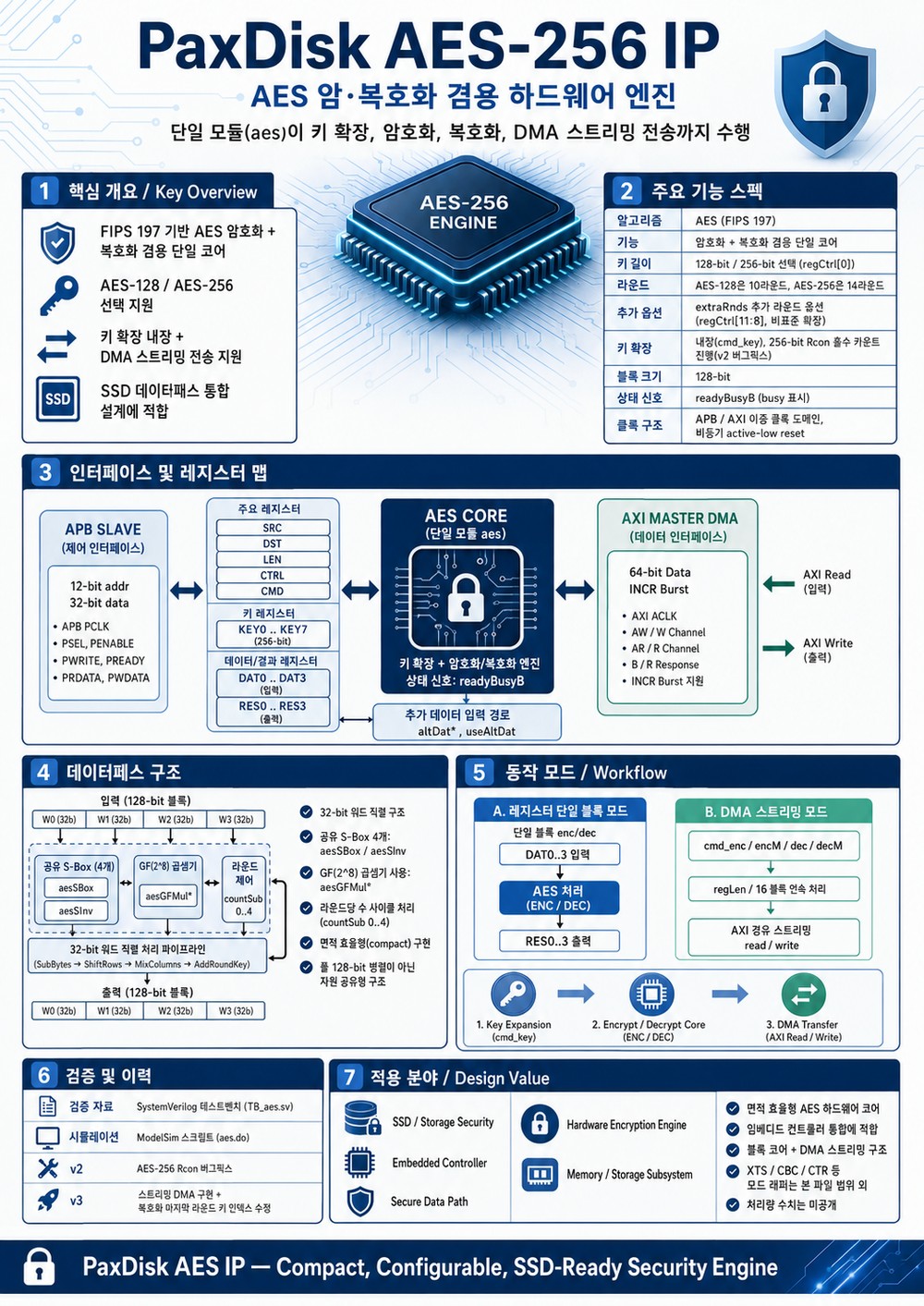
AES is the stage that encrypts the actual data with the key PBKDF2 produced. This IP is a combined engine in which one core handles key expansion, encryption and decryption, with the 128-bit or 256-bit key selected through a control register (10 or 14 rounds).
There are two operating modes: a single-block mode driven a block at a time through registers, and a DMA streaming mode in which a length is given and 128-bit blocks run continuously out through an AXI 64-bit master. Separate clock domains for APB control and AXI data keep controller integration straightforward.
The implementation is area-efficient — a 32-bit word-serial datapath sharing four S-Boxes — and is designed to be integrated into an SSD controller datapath. It completes the storage security chain of key derivation (PBKDF2), encryption (AES) and error correction (ECC) with domestic IP throughout.
| Algorithm | AES (FIPS 197) — selectable 128/256-bit key, 10/14 rounds |
|---|---|
| Operation | Single core for encryption and decryption · key expansion on board |
| Interface | APB control + AXI 64-bit DMA streaming (continuous multi-block) |
| Implementation | Area-efficient 32-bit word-serial datapath · simulation testbench available |
Architecture
Architecture
Deliverables
Included with a licence
- Synthesisable Verilog RTL and integration wrappers
- Cycle-accurate reference model and equivalence checker
- Full-chain testbench (clean / correct / UE / pad vectors)
- Datasheet, manual and integration guide (on request)
Verification toolchains: Intel/Altera (Quartus) · AMD/Xilinx (Vivado) · ASIC — process-portable RTL
Engagement
How we engage
01
IP licence
Licence the verified IP as it stands. Synthesisable RTL, the verification environment and an integration guide come with it.
02
Custom development
The IP is modified or extended to your requirement. Because we design from the interface layer up, unusual requirements can be accommodated.
03
Co-development & national programmes
Joint silicon and firmware development against platform requirements, including participation in national R&D programmes. Scope and terms are agreed case by case.
More IP
Other IP in the portfolio
Controller
SSD Controller
1.44MB to 16TB from a single controller
Interface IP
SATA 6Gbps Link / Transport
Domestic SATA Gen3 interface IP
Interface IP
UFS Host Controller (AXI4)
A JEDEC UFSHCI 3.0 host controller in pure RTL
ECC
156-bit BCH ECC
Parametric BCH codec, t = 8 … 156
ECC
QC-LDPC Error Correction
Soft-decision error correction for 3D NAND TLC / QLC
Security IP
PBKDF2-HMAC Key Derivation
Password to key — an RFC 8018 hardware engine
Processor IP
RV32IMAC RISC-V Core
A domestic 32-bit RISC-V soft processor
DSP IP
ADSP-2181 Compatible DSP Core
Replaces an obsolete DSP, running its original binaries
DSP IP
DSP56001 Compatible DSP Core
A 24-bit fixed-point DSP — in active development
DSP IP
TMS320C54x Compatible DSP Core
16-bit fixed-point DSP — single-cycle MAC, Viterbi acceleration